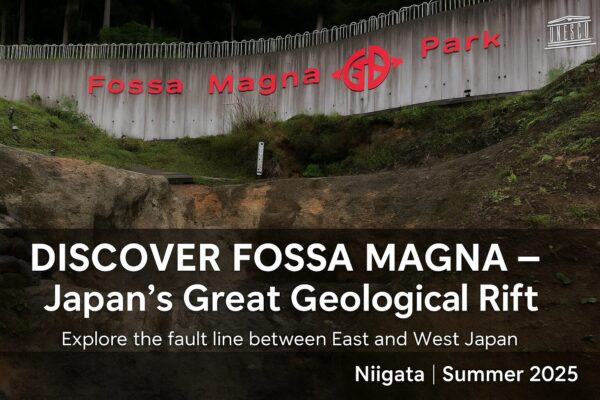
⚠️ Important Safety Updates (As of Nov 26, 2025)
- Bear Warning: “Fossil Valley” (Kaseki no Tani) has recently been closed due to bear sightings. Please check the latest information regarding this closure before visiting.
- Winter Road Closures: Roads around the park may be closed due to snow from late autumn through spring. Always check road and weather conditions before heading out.
👉 Check the latest safety information at the Itoigawa Global Geopark Official Site.)
Introduction
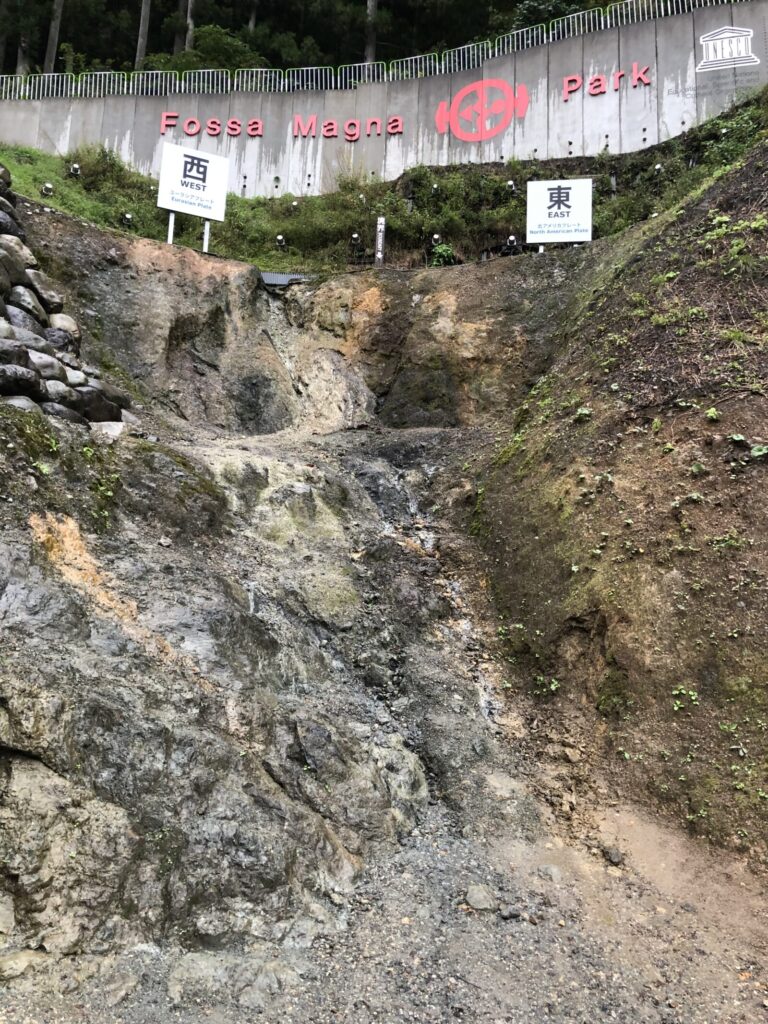
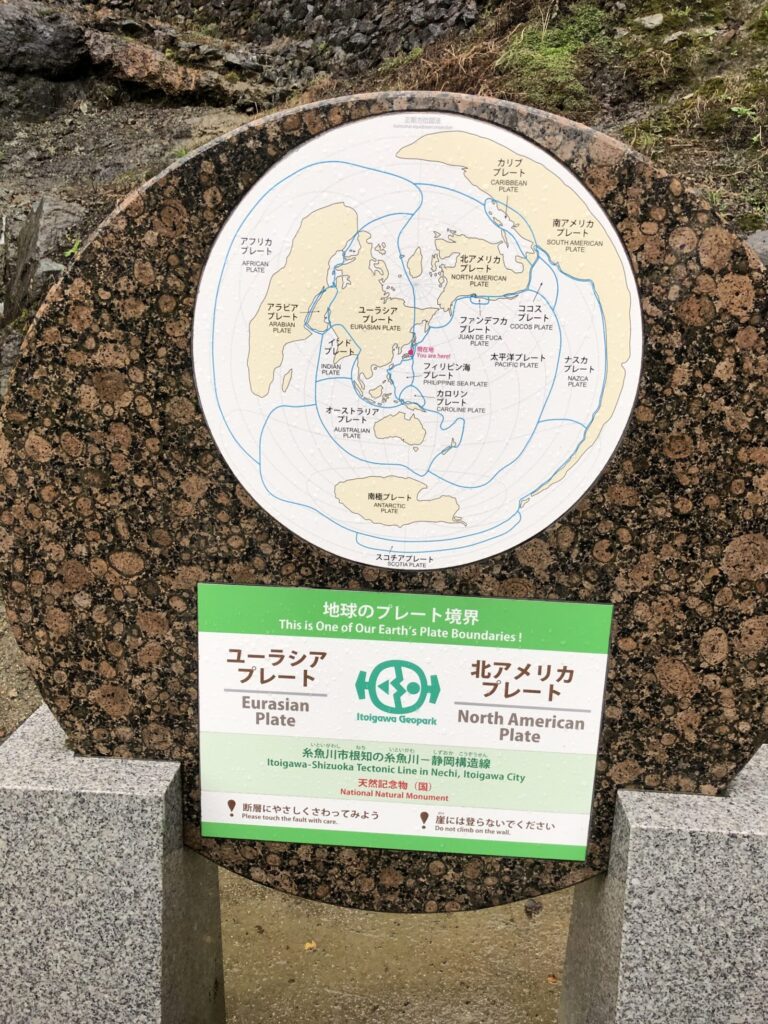
Have you ever wondered where Eastern Japan ends and Western Japan begins?
At Fossa Magna Park in Itoigawa City, Niigata Prefecture, you can actually see that boundary with your own eyes — and even reach out and touch it.
This is one of the most unique geological sites in the world: a place where rocks formed 270 million years ago sit directly beside rocks that are “only” 16 million years old. The signs are written in both Japanese and English, and the trail is gentle enough for young children.
Whether you’re a geology enthusiast, a curious traveler, or looking for an educational family day trip in Japan — this guide covers everything you need to plan your visit.
What is Fossa Magna?
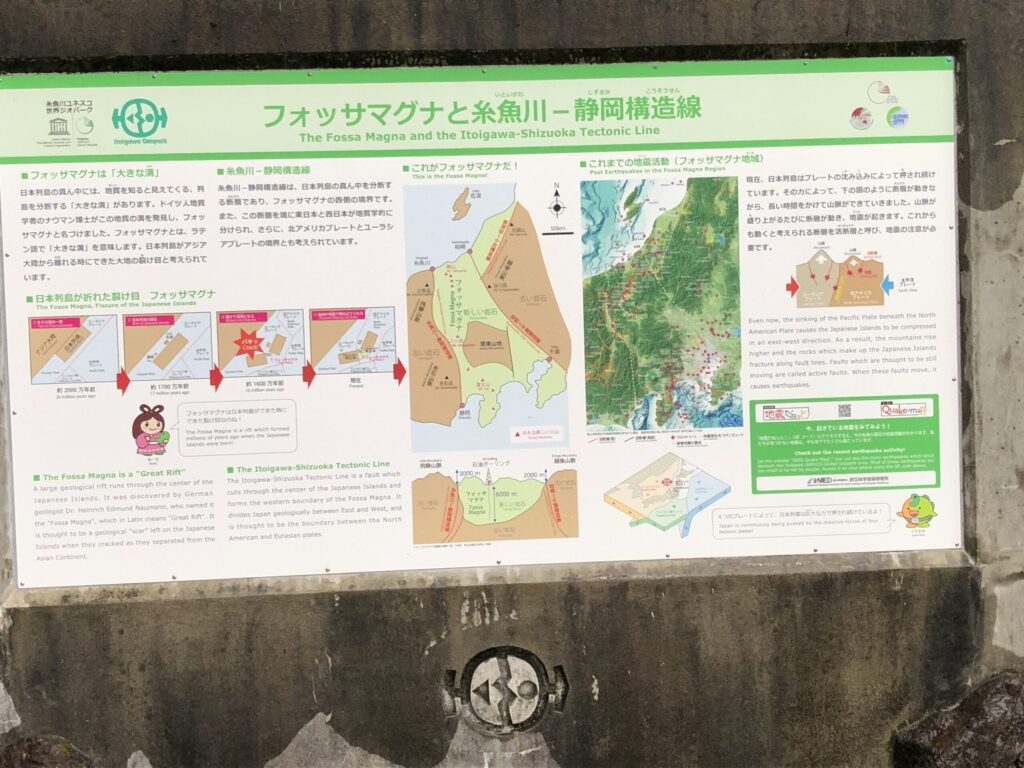
“Fossa Magna” is Latin for “great rift.” The name was given by German geologist Dr. Naumann during Japan’s Meiji era.
Geologically speaking, the Fossa Magna is a massive tectonic zone that divides Northeastern Japan from Southwestern Japan. Its western edge is defined by the Itoigawa-Shizuoka Tectonic Line (糸魚川ー静岡構造線) — a fault that stretches from the Sea of Japan coast in Niigata, through Lake Suwa, down to Shizuoka on the Pacific coast.
The area is filled with newer volcanic and sedimentary rock (formed around 20 million years ago) sitting in a basin of much older rock (100–300 million years old). In most places, this boundary is buried deep underground — but in Itoigawa’s Omachi district, it has been exposed at the surface.
That’s what makes this site extraordinary.
Visiting Fossa Magna Park: What to Expect
Fossa Magna Park is a short, family-friendly hiking site where the fault has been carefully excavated and made accessible to visitors.
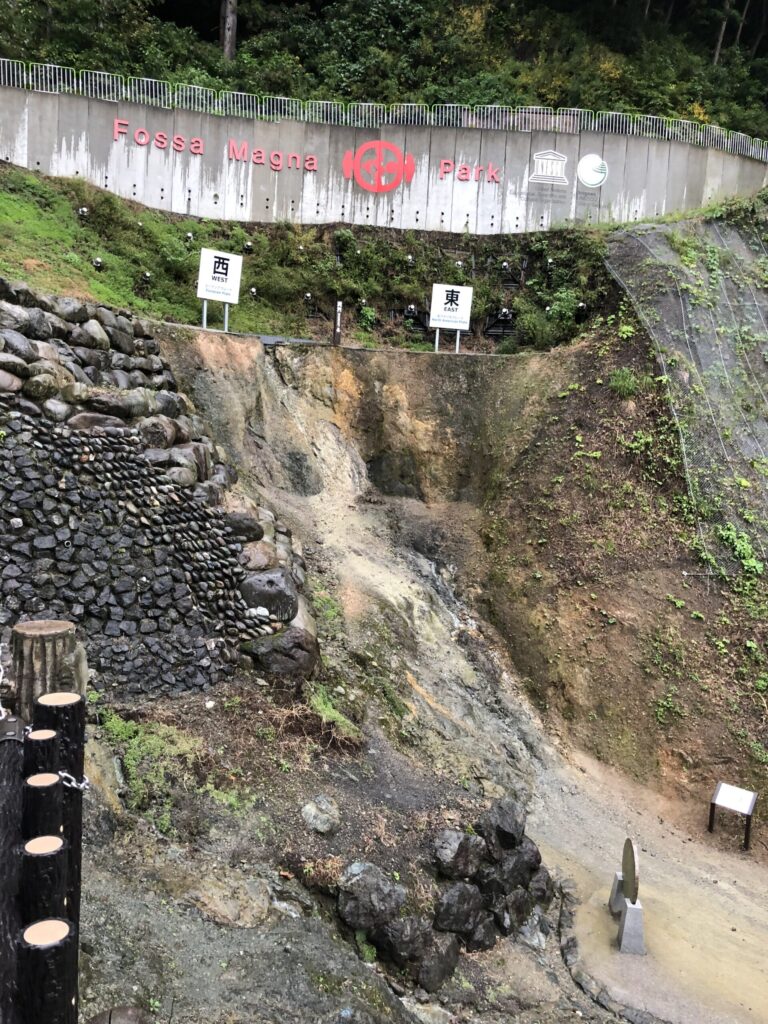
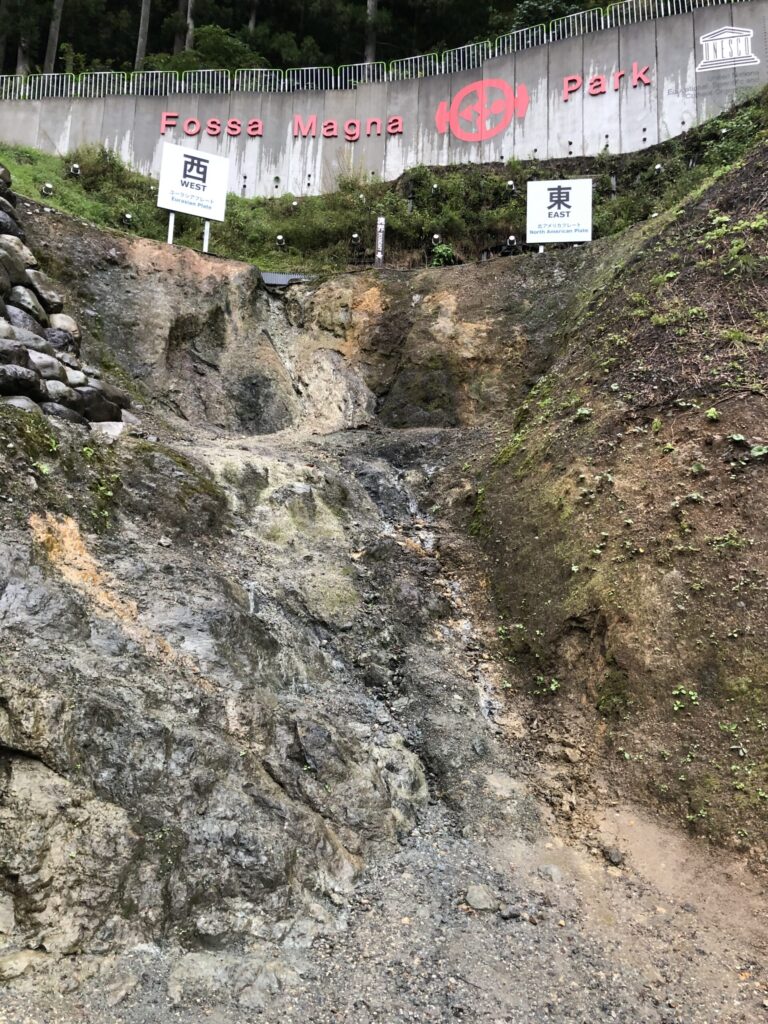
The trail leads you to an outcrop where you can see — and touch — two completely different types of rock sitting side by side:
- East side: Rock approximately 16 million years old
- West side: Rock approximately 270 million years old
The difference in color and texture is striking and surprisingly easy to see even with no geology background. The site was renovated in 2018 and now features clear, multilingual signage.
The Fault Affects More Than Just Rock — Even Sake Tastes Different!
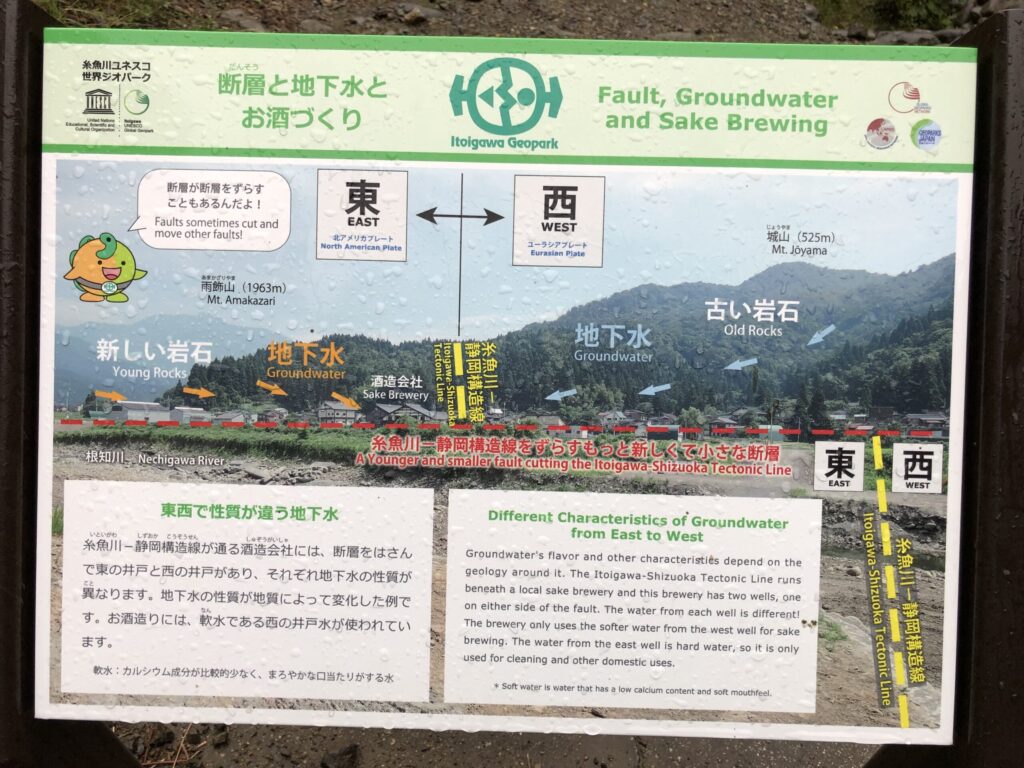
One of my favorite discoveries at the park was this bilingual sign explaining the unexpected connection between the fault and local sake brewing.
The Itoigawa-Shizuoka Tectonic Line runs directly beneath a sake brewery in the area. The brewery has two wells — one on the east side of the fault, and one on the west side — and the water from each well tastes completely different.
- West well (Young Rocks side): Soft water — smooth, low in calcium, ideal for sake brewing
- East well (Old Rocks side): Hard water — used only for cleaning and other non-brewing purposes
The brewery uses only the soft water from the west well to brew its sake. In other words, the flavor of local Japanese sake has literally been shaped by a 270-million-year-old geological boundary.
This is the kind of detail that makes Fossa Magna more than just a geology lesson — it’s a place where ancient earth and everyday Japanese culture are still connected today.
Accessibility Information
The path to the fault outcrop is steep but paved, with no stairs on the way up. While there are no stair barriers going up, descending to the main viewing platform does involve stairs. At the top, there is also a display of fault rock specimens, so those who cannot descend can still have a meaningful experience.
Plan Your Visit
Step 1: Start at the Fossa Magna Museum
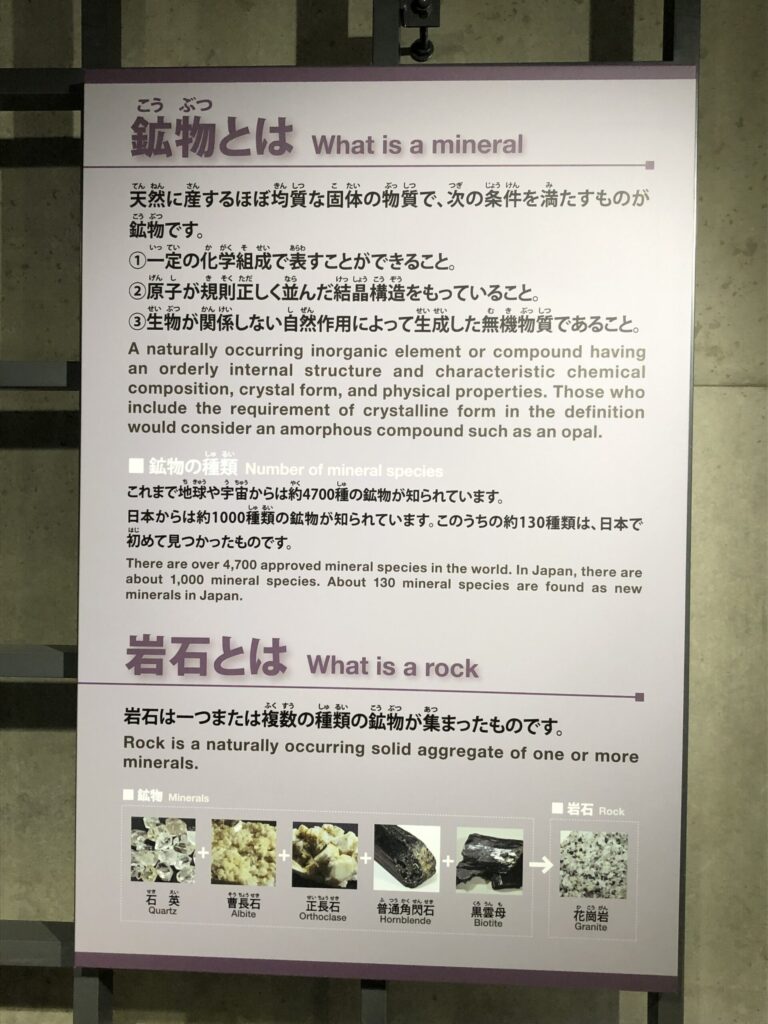
【写真を挿入:「鉱物とは・岩石とは」ミュージアム展示パネル】 Alt text: Educational panel at Fossa Magna Museum explaining the difference between minerals and rocks, with illustrations showing how quartz, albite, orthoclase, hornblende, and biotite combine to form granite.
Before heading to the park, I highly recommend spending time at the Fossa Magna Museum, located a short drive away. With interactive geological exhibits and fossil displays, it takes 2–3 hours to explore and gives great context for what you’ll see at the park.
The museum covers everything from the basics — what exactly is a mineral? what makes a rock? — all the way to the complex tectonic forces that shaped Japan. Even if you have no geology background, the bilingual Japanese-English panels make it easy to follow along.
Step 2: Getting to Fossa Magna Park
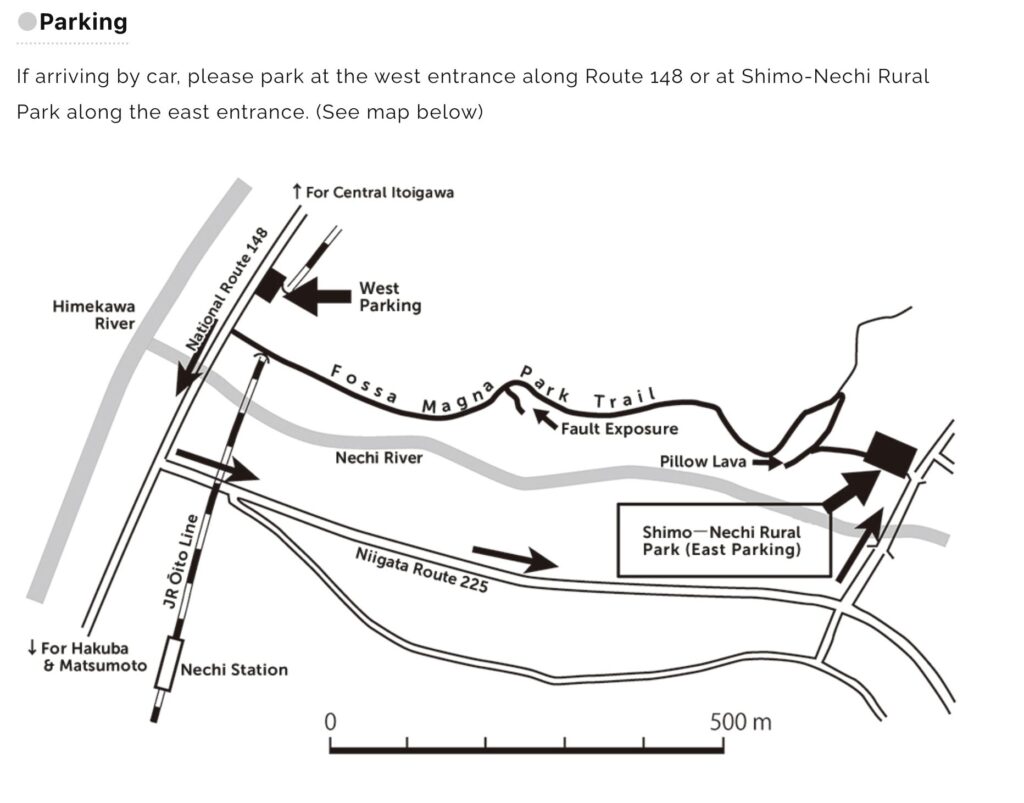
From the museum, the park parking lot is about a 20-minute drive. Public restrooms near the parking lot were clean and well-maintained during my visit.
If you’re traveling from Tokyo or Nagoya, Itoigawa Station on the Hokuriku Shinkansen is the nearest major station. A rental car is recommended for getting around the area.
⭐ Exclusive Deal: 10% OFF eSIMs! ⭐
Get 10% OFF Sim Local eSIMs Here
(Discount applied automatically at checkout)
Step 3: The Hike to the Fault
From the parking lot, follow the path toward the mountain entrance. The fault outcrop is about 500 meters from the parking lot — roughly a 10-minute walk.
The main route is paved and mostly manageable, though quite steep in sections. There is an alternative gentler slope, though its entrance is set back from the main path. The forested trail narrows in places — if you’re with young children, hold their hands on the narrower sections.
As you climb, the geological cross-section gradually comes into view. When the two-toned fault wall appears before you, it’s a genuinely breathtaking moment. To get right up to the fault face, you’ll descend a staircase to the viewing platform below.
Where to Stay in Itoigawa
Itoigawa has several accommodation options to suit different travel styles. Here are three I’d recommend:
🏨 Hotel Route-Inn Itoigawa — Best for Convenience
Right near Itoigawa Station, this business hotel is a reliable choice for travelers who want easy access with no surprises. Free Wi-Fi and breakfast included.
👉 Check availability & prices on Expedia →
🛁 Hotel Kunitomi Annex — Best for Onsen in the City
Located in the city center, this hotel offers an authentic Japanese onsen (hot spring bath) experience without having to venture far. A great combination of convenience and relaxation.
👉 Check availability & prices on Expedia →
🏔️ Sasakura Onsen Ryuunso — Best for Nature Lovers
If you want to fully unwind after a day of hiking, this secluded mountain ryokan is worth the extra drive. Think: natural hot springs, a peaceful forest setting, and traditional Japanese hospitality.
👉 Check availability & prices on Expedia →
Final Thoughts
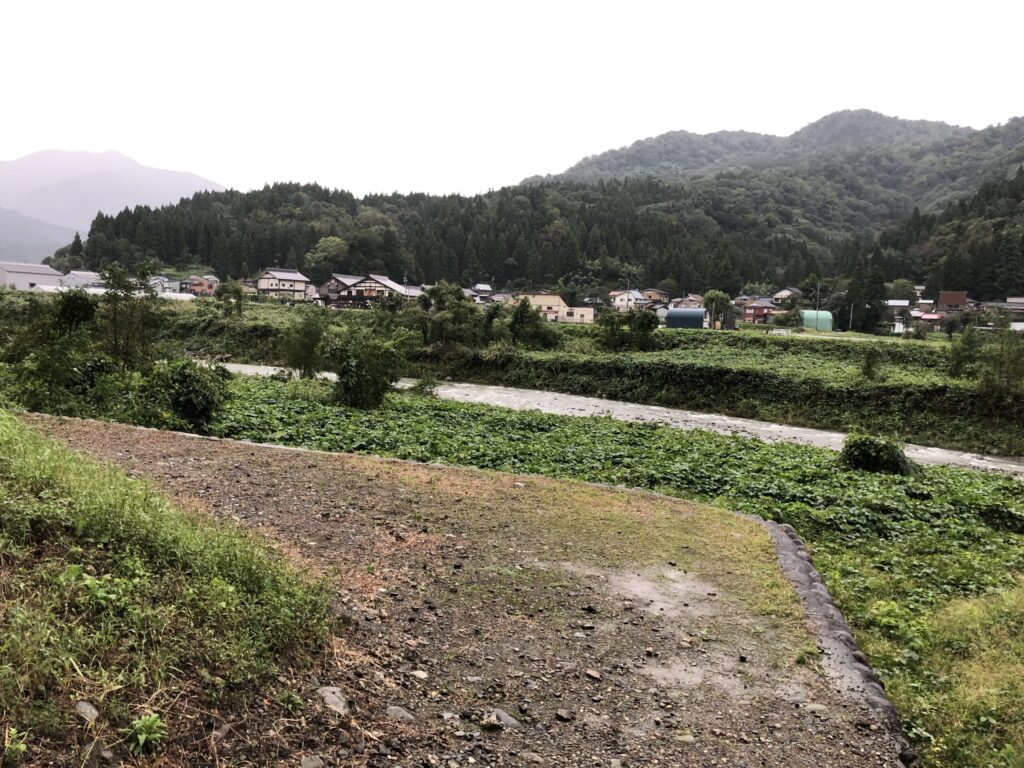
ossa Magna Park is unlike any other site I’ve visited in Japan. There’s something deeply humbling about standing at a place where two ancient pieces of the Earth have been pressed together for hundreds of millions of years.
It’s educational, accessible, and genuinely awe-inspiring — and it’s still off the radar for most tourists.
If you’re planning a trip to Niigata or the Hokuriku region, this is absolutely worth adding to your itinerary.
Comfortable walking shoes and a charged camera are all you need. See you there!


コメント